The treatment comparison in notebook 11 (11_neighborhood_enrichment.qmd) pools all cells from Adu-treated brains and compares them against all cells from IgG-treated brains, treating each cell as an independent observation. This inflates effective sample size and ignores the nested structure of the experiment: 3 biological replicates per group.
Here we take a pseudobulk approach: niche proportions are first averaged within each brain, then compared across the 3 Adu brains vs 3 IgG brains. This makes the biological replication explicit and is the appropriate unit of inference.
Note on statistical power. With n = 3 replicates per group, all tests are severely underpowered. Welch’s t-test is used here because, unlike the Wilcoxon rank-sum test (minimum two-sided p-value of 0.1 at n = 3 vs n = 3), it can in principle reach p < 0.05 when between-group differences are large relative to within-group variance. Normality cannot be verified at n = 3, so results should be interpreted as exploratory and directional.
Compute per-brain niche composition
For every plaque-proximal cell (< 50 µm from the nearest plaque), the 15 nearest spatial neighbours are identified within the same tissue slide, and the proportion of each annotated cell type among those neighbours is recorded. Proportions are then averaged to the brain level, yielding 6 brain-level observations per (plaque type × neighbour cell type) combination.
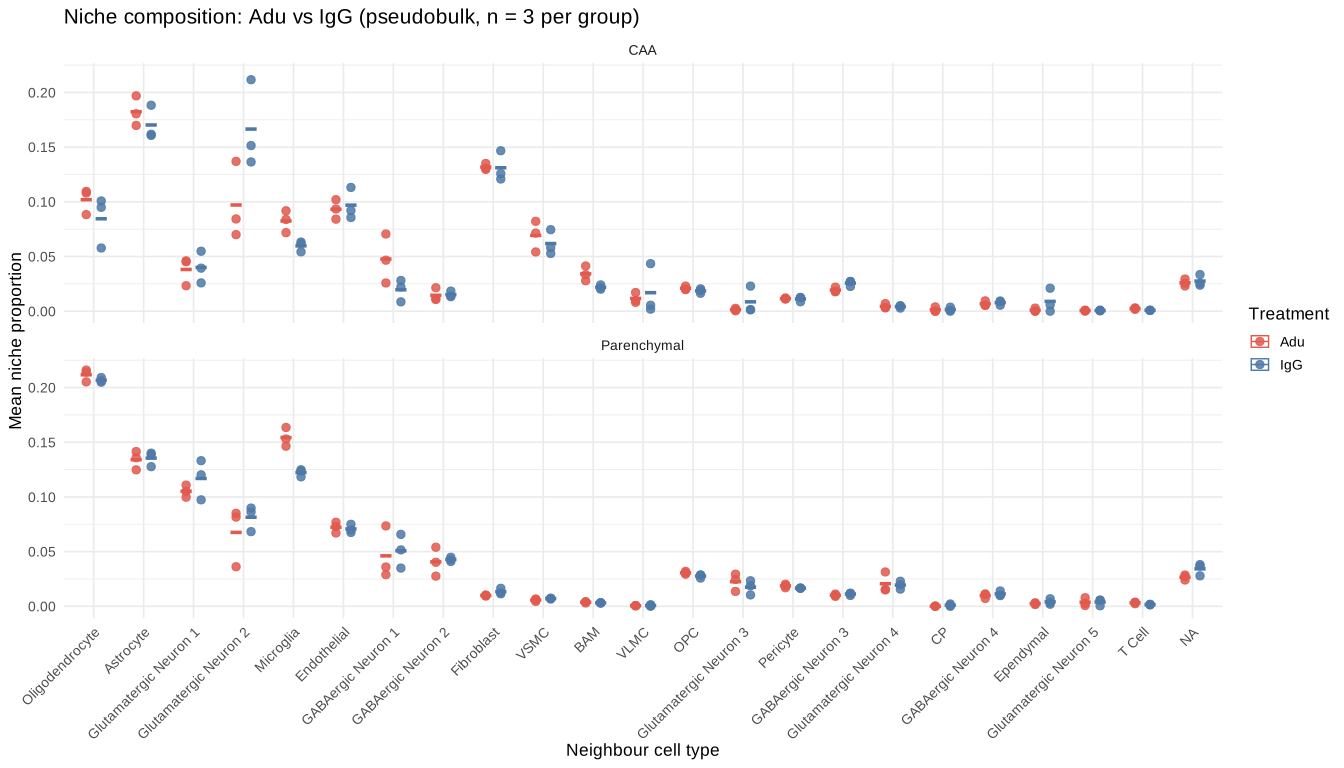
Each point represents one brain (n = 3 per group). Crossbars show group means. Plotting individual brains makes consistency (or inconsistency) of treatment effects across replicates directly visible.
Pseudobulk Welch's t-test: Adu vs IgG niche proportions (n = 3 per group)
Plaque type
Neighbour type
Mean Adu
Mean IgG
Δ (Adu − IgG)
log₂FC
p-value
p adj (BH)
CAA
GABAergic Neuron 3
0.0193
0.0256
-0.0063
-0.4095
0.036
0.504
CAA
Microglia
0.0825
0.0598
0.0227
0.4650
0.042
0.504
CAA
T Cell
0.0024
0.0008
0.0016
1.5659
0.056
0.504
CAA
BAM
0.0342
0.0219
0.0123
0.6437
0.078
0.504
CAA
Glutamatergic Neuron 2
0.0971
0.1665
-0.0694
-0.7778
0.088
0.504
CAA
GABAergic Neuron 1
0.0477
0.0196
0.0281
1.2821
0.150
0.567
CAA
OPC
0.0210
0.0186
0.0024
0.1761
0.195
0.641
CAA
Ependymal
0.0010
0.0090
-0.0080
-3.2282
0.329
0.765
CAA
Oligodendrocyte
0.1020
0.0845
0.0175
0.2708
0.333
0.765
CAA
Astrocyte
0.1824
0.1703
0.0121
0.0994
0.369
0.777
CAA
Glutamatergic Neuron 3
0.0014
0.0086
-0.0072
-2.6434
0.423
0.777
CAA
VSMC
0.0693
0.0618
0.0074
0.1639
0.518
0.851
CAA
GABAergic Neuron 4
0.0067
0.0078
-0.0011
-0.2109
0.589
0.934
CAA
NA
0.0260
0.0275
-0.0015
-0.0812
0.696
0.941
CAA
Endothelial
0.0932
0.0970
-0.0038
-0.0574
0.722
0.941
CAA
VLMC
0.0117
0.0169
-0.0053
-0.5385
0.733
0.941
CAA
Glutamatergic Neuron 5
0.0005
0.0006
-0.0001
-0.2186
0.803
0.941
CAA
Pericyte
0.0115
0.0112
0.0003
0.0442
0.816
0.941
CAA
Glutamatergic Neuron 1
0.0382
0.0400
-0.0019
-0.0689
0.876
0.941
CAA
GABAergic Neuron 2
0.0145
0.0152
-0.0006
-0.0631
0.876
0.941
CAA
Glutamatergic Neuron 4
0.0044
0.0042
0.0002
0.0784
0.879
0.941
CAA
CP
0.0013
0.0015
-0.0002
-0.2276
0.902
0.943
CAA
Fibroblast
0.1318
0.1311
0.0007
0.0074
0.940
0.961
Parenchymal
Microglia
0.1543
0.1223
0.0320
0.3356
0.014
0.504
Parenchymal
T Cell
0.0032
0.0016
0.0016
1.0243
0.048
0.504
Parenchymal
OPC
0.0306
0.0276
0.0030
0.1476
0.071
0.504
Parenchymal
NA
0.0266
0.0343
-0.0077
-0.3656
0.127
0.567
Parenchymal
Fibroblast
0.0099
0.0134
-0.0035
-0.4414
0.144
0.567
Parenchymal
VSMC
0.0057
0.0071
-0.0014
-0.3102
0.157
0.567
Parenchymal
Pericyte
0.0187
0.0166
0.0021
0.1705
0.160
0.567
Parenchymal
BAM
0.0037
0.0031
0.0006
0.2432
0.217
0.665
Parenchymal
Oligodendrocyte
0.2117
0.2067
0.0050
0.0343
0.270
0.730
Parenchymal
GABAergic Neuron 3
0.0101
0.0112
-0.0011
-0.1498
0.280
0.730
Parenchymal
CP
0.0001
0.0010
-0.0009
-3.3708
0.286
0.730
Parenchymal
Glutamatergic Neuron 1
0.1052
0.1169
-0.0117
-0.1518
0.383
0.777
Parenchymal
Ependymal
0.0025
0.0041
-0.0016
-0.7175
0.394
0.777
Parenchymal
GABAergic Neuron 4
0.0097
0.0114
-0.0017
-0.2291
0.415
0.777
Parenchymal
Glutamatergic Neuron 3
0.0225
0.0175
0.0050
0.3653
0.451
0.798
Parenchymal
Glutamatergic Neuron 2
0.0676
0.0814
-0.0139
-0.2694
0.482
0.822
Parenchymal
Endothelial
0.0723
0.0708
0.0015
0.0302
0.701
0.941
Parenchymal
VLMC
0.0006
0.0007
-0.0001
-0.3299
0.763
0.941
Parenchymal
GABAergic Neuron 1
0.0461
0.0508
-0.0046
-0.1382
0.794
0.941
Parenchymal
GABAergic Neuron 2
0.0406
0.0428
-0.0022
-0.0770
0.799
0.941
Parenchymal
Astrocyte
0.1340
0.1355
-0.0015
-0.0158
0.827
0.941
Parenchymal
Glutamatergic Neuron 4
0.0206
0.0194
0.0012
0.0874
0.850
0.941
Parenchymal
Glutamatergic Neuron 5
0.0038
0.0039
-0.0001
-0.0433
0.969
0.969
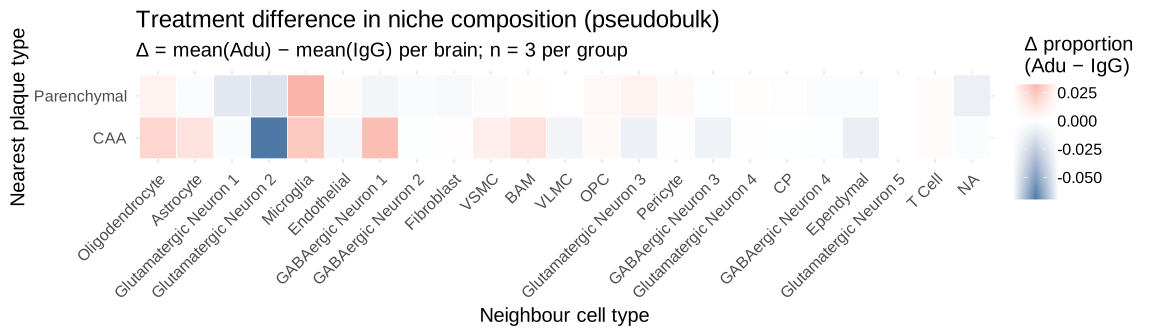
Difference heatmap (Adu − IgG)
Red tiles indicate cell types proportionally more abundant in Adu niche; blue tiles indicate depletion relative to IgG. The colour scale shows the raw difference in mean niche proportion.
Code
ttest_results |>ggplot(aes(x = neighbour_type, y = nearest_type, fill = delta)) +geom_tile(colour ="white") +scale_fill_gradient2(low ="#4E79A7", mid ="white", high ="#E05A4E", midpoint =0,name ="Δ proportion\n(Adu − IgG)" ) +labs(title ="Treatment difference in niche composition (pseudobulk)",subtitle ="Δ = mean(Adu) − mean(IgG) per brain; n = 3 per group",x ="Neighbour cell type",y ="Nearest plaque type" ) +theme_minimal(base_size =15) +theme(axis.text.x =element_text(angle =45, hjust =1))