Code
source("R/setup.R")
library(compareGroups)

data <- load_slides_and_distances("full")
slide1 <- data$slide1; slide2 <- data$slide2
cell_distances_1 <- data$distances_1; cell_distances_2 <- data$distances_2ThioS quantification and HALO analysis
source("R/setup.R")
library(compareGroups)
data <- load_slides_and_distances("full")
slide1 <- data$slide1; slide2 <- data$slide2
cell_distances_1 <- data$distances_1; cell_distances_2 <- data$distances_2All annotations performed by Akhil Palleria (single annotator; no inter-observer variability).
Thioflavin-S (ThioS)-positive amyloid plaques were quantified across six brain samples (Brain1–6; IgG control, n=3; Aducanumab-treated, n=3) using HALO image analysis software, with all annotations performed by a single rater (A.P.) to eliminate inter-observer variability.
Two plaque phenotypes were identified: cerebrovascular (CAA) and parenchymal plaques. Across all brains, parenchymal plaques were substantially more numerous than CAA plaques, with per-brain counts ranging from 2,681 to 3,961 (parenchymal) versus 284 to 446 (CAA). Consistent with this, parenchymal plaques accounted for the majority of total annotated area in every sample.
t1 <- bind_rows(thios_1, thios_2) |>
  group_by(brain, sample, plaque_type) |>
  summarise(
    n_plaques  = n(),
    total_area = sum(Area),
    .groups    = "drop"
  )

t1 |> kbl() |> kable_styling("striped")| brain | sample | plaque_type | n_plaques | total_area |
|---|---|---|---|---|
| Brain1 | KK4_465 | CAA | 345 | 37005.25 |
| Brain1 | KK4_465 | Parenchymal | 3961 | 417446.50 |
| Brain2 | KK4_492 | CAA | 446 | 58097.50 |
| Brain2 | KK4_492 | Parenchymal | 2681 | 512135.00 |
| Brain3 | KK4_504 | CAA | 366 | 46653.50 |
| Brain3 | KK4_504 | Parenchymal | 2760 | 338232.25 |
| brain4 | KK4_496 | CAA | 389 | 35432.25 |
| brain4 | KK4_496 | Parenchymal | 3559 | 367226.00 |
| brain5 | KK4_502 | CAA | 370 | 44558.75 |
| brain5 | KK4_502 | Parenchymal | 3187 | 441707.00 |
| brain6 | KK4_464 | CAA | 284 | 22620.00 |
| brain6 | KK4_464 | Parenchymal | 2743 | 276220.25 |
Group-level comparison revealed no statistically significant difference between Aducanumab-treated and IgG-control animals in either total CAA area (41,759 ± 17,904 vs. 39,697 ± 6,076 µm²; p=0.865), total parenchymal plaque area (410,021 ± 121,107 vs. 374,302 ± 40,078 µm²; p=0.668), or the proportion of total plaque burden attributable to CAA (8.97 ± 1.32% vs. 9.69 ± 2.13%; p=0.653).
t1_wide <- t1 |>
  pivot_wider(id_cols = c(brain, sample), names_from = plaque_type, values_from = total_area) |>
  mutate(CAA_percent = CAA / (Parenchymal + CAA) * 100) |>
  inner_join(sample_dict, by = c("brain", "sample"))

caa1 <- compareGroups(treatment ~ CAA + Parenchymal + CAA_percent, data = t1_wide)
export2md(createTable(caa1, show.p.overall = T), caption = "")| Adu | IgG | p.overall | |
|---|---|---|---|
| N=3 | N=3 | ||
| CAA | 41759 (17904) | 39697 (6076) | 0.865 |
| Parenchymal | 410021 (121107) | 374302 (40078) | 0.668 |
| CAA_percent | 8.97 (1.32) | 9.69 (2.13) | 0.653 |
To enable spatial co-registration with single-cell Xenium transcriptomic data, the centroid of each plaque was computed as the midpoint of the HALO bounding box and converted from pixel coordinates to micrometres using a calibration factor of 0.2125 µm/pixel. This coordinate transformation provides a common spatial reference frame for subsequent nearest-neighbour analyses.
Centroid and distance functions are defined in R/setup.R and computed by load_slides_and_distances().
Minimum Euclidean distances from each Xenium-profiled cell to its nearest CAA plaque (dist_caa) and nearest parenchymal plaque (dist_paren) were computed using a k-d tree algorithm. The resulting distance distributions were markedly different between plaque types. For CAA plaques, the distribution had a modal distance of approximately 200–300 µm and a long tail extending to ~1,500 µm, reflecting the relatively sparse and focal distribution of vascular amyloid deposits. By contrast, the majority of cells were within ~50 µm of a parenchymal plaque, consistent with the dense and spatially pervasive distribution of diffuse parenchymal amyloid observed histologically.
bind_rows(cell_distances_1, cell_distances_2) |>
  pivot_longer(c(dist_caa, dist_paren), names_to = "plaque_type", values_to = "min_dist") |>
  ggplot(aes(x = min_dist)) +
  geom_histogram(binwidth = 50, fill = "lightgray", col = "black") +
  labs(x = "min. dist (µm)") +
  facet_wrap(~plaque_type, scales = "free") +
  theme_minimal() +
  theme(strip.text = element_text(size = 14))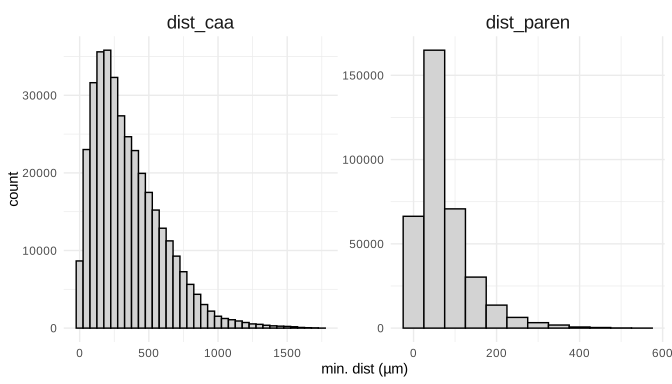
Each cell was assigned to either the CAA or parenchymal plaque neighbourhood based on which plaque type was spatially closer.
Across the six samples (n = 51,959–69,664 cells per brain), the large majority of cells were classified as parenchymal-proximal (87.5–92.9% per sample), with 7.4–12.5% classified as CAA-proximal, broadly reflecting the disparity in plaque abundance between types. Between 4.1–6.6% of cells per sample fell within the 50 µm CAA proximity threshold, while 38.5–52.2% of cells were within 50 µm of a parenchymal plaque.
Each cell is assigned to whichever plaque type is nearest: CAA if dist_caa < dist_paren, Parenchymal otherwise.
classify_proximity <- function(dist_data) {
  dist_data |>
    column_to_rownames("cell") |>
    mutate(
      caa = case_when(
        dist_caa < 50  ~ "<50um",
        dist_caa >= 50 ~ "≥50um"),
      parenchymal = case_when(
        dist_paren < 50                        ~ "<50um",
        dist_paren >= 50 & dist_paren < 150   ~ "50-150um",
        dist_paren >= 150                      ~ "≥150um"),
      classification = if_else(dist_caa < dist_paren, "CAA", "Parenchymal")
    ) |>
    select(dist_caa:classification)
}

slide1 <- AddMetaData(slide1, classify_proximity(cell_distances_1))
slide2 <- AddMetaData(slide2, classify_proximity(cell_distances_2))md <- bind_rows(slide1@meta.data, slide2@meta.data)
c1 <- compareGroups(sample_ID ~ caa + parenchymal + classification, data = md, max.ylev = 6)
export2md(createTable(c1, show.p.overall = FALSE), caption = "Per sample")| KK4_464 | KK4_465 | KK4_492 | KK4_496 | KK4_502 | KK4_504 | |
|---|---|---|---|---|---|---|
| N=60064 | N=57104 | N=71401 | N=60182 | N=53359 | N=56289 | |
| caa: | ||||||
| <50um | 2540 (4.23%) | 2658 (4.65%) | 3865 (5.41%) | 3452 (5.74%) | 2665 (4.99%) | 3590 (6.38%) |
| ≥50um | 57524 (95.8%) | 54446 (95.3%) | 67536 (94.6%) | 56730 (94.3%) | 50694 (95.0%) | 52699 (93.6%) |
| parenchymal: | ||||||
| <50um | 24409 (40.6%) | 29621 (51.9%) | 26340 (36.9%) | 32095 (53.3%) | 25575 (47.9%) | 24012 (42.7%) |
| ≥150um | 8559 (14.2%) | 4908 (8.59%) | 11155 (15.6%) | 3287 (5.46%) | 3824 (7.17%) | 6522 (11.6%) |
| 50-150um | 27096 (45.1%) | 22575 (39.5%) | 33906 (47.5%) | 24800 (41.2%) | 23960 (44.9%) | 25755 (45.8%) |
| classification: | ||||||
| CAA | 5975 (9.95%) | 3962 (6.94%) | 8227 (11.5%) | 5028 (8.35%) | 4249 (7.96%) | 5781 (10.3%) |
| Parenchymal | 54089 (90.1%) | 53142 (93.1%) | 63174 (88.5%) | 55154 (91.6%) | 49110 (92.0%) | 50508 (89.7%) |
c2 <- compareGroups(Treatment.Group ~ caa + parenchymal + classification, data = md)
export2md(createTable(c2), caption = "Per treatment group")| Adu | IgG | p.overall | |
|---|---|---|---|
| N=184824 | N=173575 | ||
| caa: | <0.001 | ||
| <50um | 9070 (4.91%) | 9700 (5.59%) | |
| ≥50um | 175754 (95.1%) | 163875 (94.4%) | |
| parenchymal: | 0.000 | ||
| <50um | 76324 (41.3%) | 85728 (49.4%) | |
| ≥150um | 23538 (12.7%) | 14717 (8.48%) | |
| 50-150um | 84962 (46.0%) | 73130 (42.1%) | |
| classification: | <0.001 | ||
| CAA | 18451 (9.98%) | 14771 (8.51%) | |
| Parenchymal | 166373 (90.0%) | 158804 (91.5%) |
Pseudoreplication warning: these cell-level statistics treat each cell as independent, but the true unit of replication is the brain (n = 3 per group). P-values are therefore inflated and should not be used for formal inference. See pseudobulk DE in notebooks 7 and 8 for properly replicated treatment comparisons.